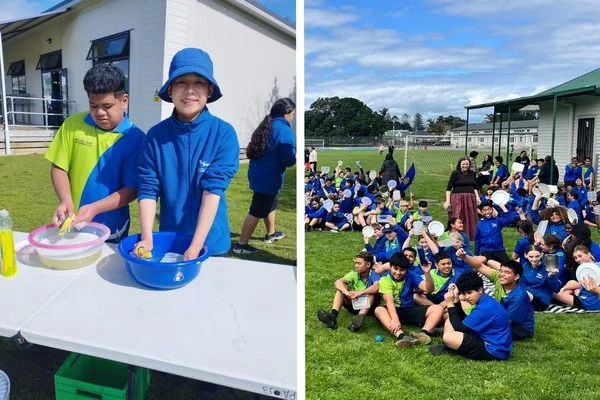
Royal Oak Intermediate (ROI) recently had their school hangi and actively planned for it to be as zero-waste as they could. The inspiration started from a visit to 312 Day last year - a local community festival that ran as a zero-waste event, complete with reusable dining equipment and a wash station.
Sheryl Campbell, a teacher at ROI, attended 312 Day and was so inspired that she got stuck in and washed dishes at the event for almost an hour! While she washed she chatted to Sarah Lightbody from Tāmaki WRAP about the zero waste aspects of this large event.
She planned as she washed: how could she make the Year 8 graduation in four days’ time zero waste?
“I’ve always been concerned about our school events because we are so good at sorting our waste in the classroom, composting and recycling a lot of our classroom waste, but our events always end up with lots of waste to landfill. It sends the wrong message to the students.”
She’d tried to improve things at school events in the past but said it just hadn’t been successful.
“At 312 Day, I saw how it could be done.”
She decided to start with her class and one other for the 2025 Year 8 graduation dinner. A quick email to whānau explained the concept and got everyone on board. Then she sourced enough plates and cutlery - topping up what she already had at school from the op shops.
“The kids set it up and it looked so lovely - we had proper tablecloths, and it was set with the plates and cutlery. It looked so much better than in the past with the plastic tablecloths and disposable plates and cutlery. The response from the students and their whānau was so positive. Several students even offered to wash the dishes!”
The whole thing went smoothly and Sheryl started thinking about school events for 2026.
“I loved that this was a follow through from our classroom waste sorting system. It extends what we do in the classroom so that our families also become more aware of waste.”
Roll on into 2026 and plans for the school hangi
Luke Coughlan was in charge of planning the hangi, a new task for him.
“The complete honest truth is, the only reason we decided we could try and go zero waste was because Sarah from Tāmaki WRAP had offered her support and had enough enthusiasm for the both of us. In my day to day, I am always trying to balance being effective and being efficient.”
Doing something like being zero waste was going to be too much to take on by himself, even with Sheryl’s support. This was a much bigger challenge: how do you have enough reusable plates and cutlery for a whole school? This was overcome by good communication. Students were encouraged to bring their own plates and cutlery, and lidded containers to take home leftovers. Tāmaki WRAP loaned their wash station and reusable dining kit to top up for those who forgot plates and for whānau attending the hangi.
There was a lot of learning along the way:
“I didn’t know that bones couldn’t go in our compost system. Furthermore, I was unaware that feeding food scraps to pigs or putting it in the compost still counted as food waste. I learned that the definition of food waste is that the people didn't end up eating the food,” says Luke.
There are always things that can be done better, and plans are underway to make next year's zero waste school hangi even more successful.
“We noticed that some students brought paper plates. Next year, we will have to be a bit more explicit with the what and the why.”
Luke also says he wants to involve parents more in the preparation and will put out comms asking for help next time.
Making the school hangi zero waste has been a proud moment for Luke.
“I love it when the community comes together. The bonding we experienced through the synergy created in preparations, and the event was invaluable. Having food that was grown in the community garden was also a very nice touch. Now that we have done it once, repeating the successes and building on them will be far easier. Knowing that Tāmaki WRAP is on hand to advise and the reusable dining kit is available for such reasonable prices, there is no reason we can't involve them in our Year 8 graduation where 200 families bring plates for a big shared lunch. While the food containers will be difficult to control, the plates and utensils could be borrowed, and it will be an improvement on the existing model, that we can look to build on in future years as we begin to build a zero-waste culture.”